When a Stranger Opens the Door: Why Saying Yes Might Be the Best Travel Decision You Ever Make
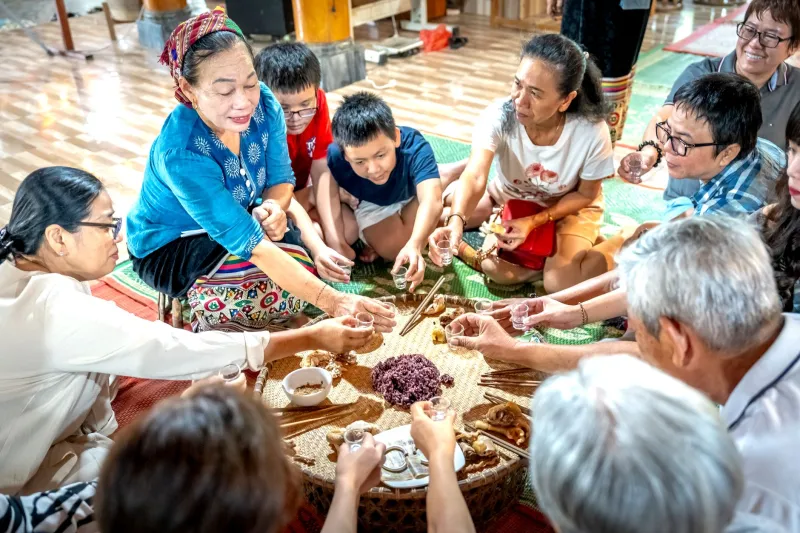
There's a particular kind of moment that experienced travelers recognize instantly. You're standing somewhere unfamiliar — a market lane in Oaxaca, a harbor town in Croatia, a village square in rural Vietnam — and someone you've never met turns to you with an unmistakable gesture: come with us. Maybe it's a nod toward a courtyard where music is already spilling into the street. Maybe it's a hand extended over a table crowded with food. Maybe it's just a smile and a few words you don't fully understand, but whose meaning is somehow completely clear.
In that moment, every cautious instinct you've ever been handed kicks in. Don't talk to strangers. Don't accept invitations from people you don't know. Stay on the path.
And yet. Some of the most vivid, most human, most genuinely alive travel stories begin with someone choosing to ignore all of that — and stepping through the door anyway.
What Guidebooks Can't Manufacture
Here's the honest truth about travel planning: no matter how deep you go on Reddit threads or how many hours you spend with a Lonely Planet, you cannot schedule an authentic human connection. You can book a cooking class. You can reserve a table at a locally-owned restaurant. You can hire a guide who grew up in the neighborhood. All of those things have real value.
But they're not the same as a retired schoolteacher in Porto who spots you looking lost outside a bakery and ends up walking you through her entire childhood neighborhood for two hours, pointing at buildings and telling stories that no tour operator has ever thought to include on a map.
That kind of encounter doesn't have a price point. It doesn't have a TripAdvisor listing. It exists entirely outside the transaction economy of modern tourism — and it's only available to travelers who are willing to be surprised.
A friend who spent three weeks moving through rural Japan described it this way: "I kept thinking I needed to find the real Japan. And then one afternoon a farmer I couldn't communicate with invited me to help him harvest persimmons, and I realized — this is it. This is the most real thing I've done the entire trip."
The Art of Reading the Room
Now, let's be straight about something. Saying yes to strangers doesn't mean abandoning your judgment. It means sharpening it.
There's a meaningful difference between a genuine, culturally rooted invitation and a situation that's designed to exploit a tourist's eagerness to connect. Learning to tell the difference is part of what makes you a more capable traveler — and it's a skill that develops over time.
Some markers of genuine invitations: they come without financial pressure, they're extended in a public or semi-public setting, they include other people (families, groups, communities), and the person extending them seems more interested in sharing something than in getting something. Scams, by contrast, tend to involve urgency, isolation, and a pivot toward money or obligation at some point in the interaction.
Trust your read of a situation. If something feels performative or pushy, it probably is. But if something feels warm and unscripted — if it feels like you've accidentally wandered into the middle of someone's real life — that's usually exactly what's happening.
Practical habits help too. Tell someone where you're going. Keep your phone charged. Stay in spaces where other people are present, at least early in an unexpected encounter. None of this has to kill the spontaneity. It just means you're showing up to the adventure with your eyes open.
Stories That Only Happen Once
Ask almost any long-term traveler to name the experience that changed them most, and odds are good it won't be a landmark or a museum. It'll be a moment of unexpected human contact.
A solo traveler in Tbilisi, Georgia described wandering into a neighborhood she hadn't planned to visit and being pulled into a supra — the elaborate Georgian feast that functions as both a meal and a ceremony — by a family celebrating a birthday. She stayed for four hours. She couldn't speak Georgian. She cried twice. She still calls it the best night of her life.
A couple traveling through Morocco found themselves invited to help set up a neighborhood festival in the medina — stringing lights, moving chairs, carrying trays of food — and ended up spending an entire evening as honorary participants in a celebration that had nothing to do with tourism and everything to do with community.
These aren't exceptional people with exceptional luck. They're travelers who were paying attention, who were open, and who — when the moment came — chose yes over no.
What You Actually Bring to the Exchange
It's easy to frame these encounters as things that happen to travelers — gifts handed down from locals to visitors. But that framing misses something important.
When you accept an invitation genuinely, you're also bringing something. You're bringing curiosity, presence, and a willingness to be a little bit vulnerable. You're signaling that you see the person in front of you as a full human being worth knowing, not a backdrop to your vacation. That matters. In a world where mass tourism has trained many communities to interact with visitors as consumers rather than people, the traveler who shows up as a person stands out.
Some of the most meaningful cross-cultural connections happen not because one side gave and the other received, but because both people were genuinely interested in each other. That's a two-way thing. And you have more to offer it than you might think.
How to Make Yourself Available to Unexpected Invitations
If this kind of travel sounds appealing but you're not sure how to access it, the answer is simpler than you'd expect: slow down and linger.
Unexpected invitations don't find travelers who are always in motion, always with headphones in, always checking the next thing off the list. They find the person sitting alone at a café table for an extra hour, or wandering a neighborhood market without a destination, or stopping to watch something without immediately reaching for a camera.
Be somewhere long enough to become slightly familiar. Make eye contact. Smile first. Learn a handful of words in the local language — even badly pronounced greetings signal that you're trying, and that signal opens doors.
And when the moment comes — when someone waves you over, when a door opens that you didn't expect — remember that the story you'll tell for the rest of your life is probably on the other side of it.
The best travel isn't always the travel you planned. Sometimes it's the travel that finds you, in the middle of an ordinary afternoon, through the simple generosity of a stranger who decided you looked like someone worth knowing.