The Art of Going Nowhere Fast: How Choosing the Long Way Around Changes the Traveler You Become
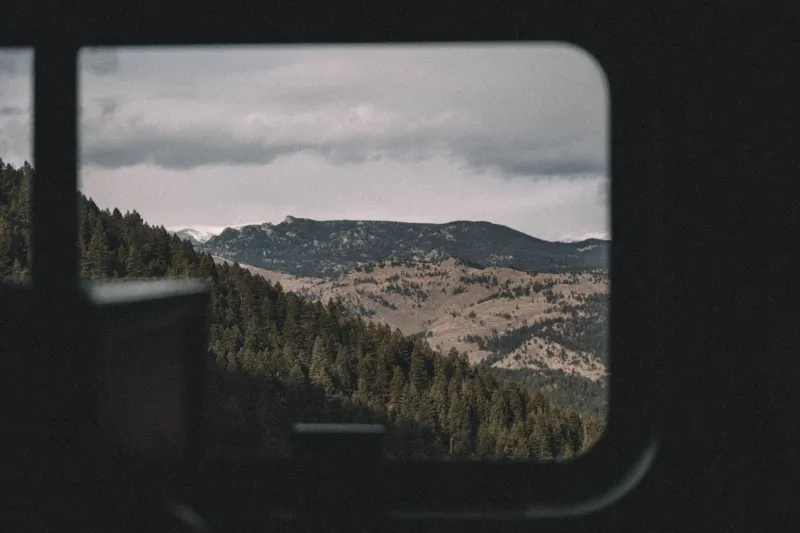
There's a particular kind of satisfaction that comes from a two-hour flight. You fold yourself into a seat, stare at a tiny screen, eat something wrapped in plastic, and then — almost magically — you're somewhere else. Efficient. Clean. Done.
But here's the thing nobody talks about: you haven't actually traveled anywhere. You've been transported. And those two things, it turns out, are wildly different.
More and more, a certain kind of wanderer is pushing back against the optimization of movement. They're booking the overnight train instead of the 90-minute flight. They're renting a car and taking the coastal two-lane instead of the interstate. They're waking up early to walk a city before it opens its eyes. Not because they don't value their time — but because they've figured out that the journey itself is where a lot of the good stuff lives.
The Problem With Arrival Culture
We've built modern travel almost entirely around the destination. The hotel. The landmark. The restaurant. The photo. Everything in between is treated like dead air — something to compress, skip, or sleep through.
But that framing has a cost. When you fly over a landscape, you don't develop a relationship with it. You don't feel the way the terrain shifts from flat to mountainous, or watch a coastline reveal itself mile by mile. You don't pass through the small towns that exist between the famous ones — the places that haven't been written up in any magazine but somehow feel more real than anywhere you'll visit on your itinerary.
Arrival culture turns countries into highlight reels. And highlight reels, no matter how beautiful, are never the whole story.
What Slow Movement Actually Does to You
Take a long-distance train journey — say, the California Zephyr from Chicago to San Francisco, which rolls through nearly 2,500 miles of American landscape over about 51 hours. Most people, when they hear that, think: why would anyone do that when you can fly in four hours?
But ask someone who's made that trip. They'll tell you about waking up somewhere in the Colorado Rockies with the light just starting to hit the canyon walls. They'll describe conversations with strangers in the dining car — a retired teacher from Ohio, a young couple relocating to Portland, a guy who's been riding that train every year for a decade just because he loves it. They'll talk about how the scale of the country started to make sense in a way it never had from 35,000 feet.
That's not inefficiency. That's immersion.
The same thing happens when you walk a city instead of cabbing between its attractions. You find the bakery that's been there since 1952. You stumble into a neighborhood festival that wasn't in any guidebook. You notice the architectural details above the storefronts, the murals in the alleys, the way the energy shifts between blocks. The city stops being a collection of pins on a map and starts being a place that actually exists.
The Landscape Is the Point
Here's something worth sitting with: in most parts of the world, the land between destinations is extraordinary. We just never look at it.
Drive the Pacific Coast Highway instead of I-5 and you'll spend hours watching the ocean appear and disappear around every bend. Take the ferry between islands in Greece instead of the quick flight and you'll understand why sailors used to write poems about the Aegean. Choose the mountain road through the Appalachians instead of the highway and you'll arrive at your destination having actually seen something of the place you've been moving through.
Slow travel is, at its core, an argument that geography matters. That the land shapes the people who live on it, and that you can't really understand a culture without understanding its landscape. You can't appreciate coastal Maine by flying into Portland. You have to smell the salt air, watch the fog roll in, feel the cold even in August.
Resisting the Urge to Optimize
This is genuinely hard for Americans. We are, culturally, a people who optimize. We find the fastest route, the best deal, the most efficient itinerary. There's real value in that — but applied to travel, it tends to produce experiences that are expensive, exhausting, and weirdly forgettable.
The antidote isn't to abandon planning altogether. It's to build in deliberate inefficiency. To look at your itinerary and ask: where am I just passing through? What would happen if I slowed down there instead?
Maybe it means adding a day to your road trip and taking the scenic byway. Maybe it means choosing a cruise or a train for a leg of the journey you'd normally fly. Maybe it just means putting the phone away and walking for two hours without a destination.
None of these things are complicated. They just require the willingness to resist the pull of maximum efficiency — which, in travel, is always the pull toward the surface.
The Traveler You Become on the Long Road
There's a version of travel that checks boxes. And there's a version that changes something in you. The difference, more often than not, comes down to pace.
When you slow down, you start to notice. When you notice, you start to connect. When you connect — with a landscape, with a stranger, with a culture you're only beginning to understand — you stop being a tourist moving through a place and start being a traveler actually in it.
Marco Polo didn't fly. He rode, walked, sailed, and took years to cross the world. And what he brought back wasn't just a list of places — it was a profound understanding of how those places worked, what made them distinct, and how they fit together across the vast landscape of the world.
You don't have to take years. But you might consider taking the long way.
It's slower, sure. It's less efficient, absolutely. But it's also where most of the real travel happens — in the hours between the destinations, on the roads that don't show up in the highlights, in the ordinary moments that somehow end up being the ones you remember most.