What the Noise Drops Away: How Getting Lost in Translation Teaches You to Actually See
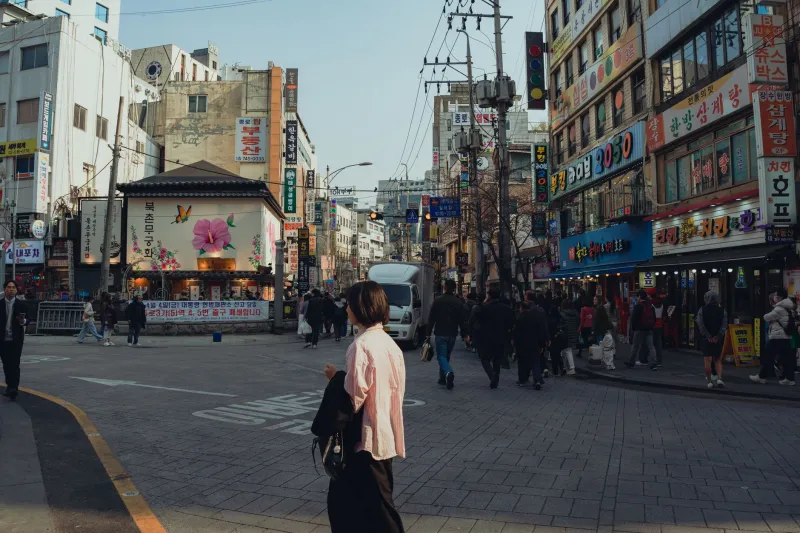
There's a particular kind of quiet that settles over you when you step off a train in a city where you don't speak the language. Not silence exactly — the street is probably loud, the market is probably chaotic, someone is almost certainly honking a horn. But inside your own head, something drops away. The constant hum of verbal processing, the reflex to eavesdrop, the automatic sorting of conversations into relevant and irrelevant — all of it goes still.
What fills that space is something most of us haven't felt since childhood: pure, unfiltered observation.
The Language You Didn't Know You Were Relying On
Back home, language is ambient. It's the radio in the coffee shop, the overheard argument at the next table, the billboard you read without meaning to. Even when you're not trying to listen, your brain is processing words — categorizing, filing, reacting. It's exhausting, and most of us don't even notice we're doing it.
When you land somewhere that language doesn't reach you — rural Japan, a mountain village in Morocco, a market town in the Georgian Caucasus — that channel goes quiet. And the silence is disorienting at first. You feel exposed, maybe a little helpless. You reach for your phone. You look for something familiar to anchor yourself.
But if you resist that reflex, even briefly, something interesting starts to happen.
You begin to see.
Reading the Room Without a Rosetta Stone
Watch the way a vendor in a Thai night market handles a customer she clearly knows well versus one she's never seen before. The body shifts differently. The hands move with more ease. The eyes do something subtle and warm. You don't need a word of Thai to understand that you're watching a friendship play out in real time — one that probably stretches back years, maybe decades.
Or notice the choreography of a busy Neapolitan café at 7 a.m. The barista who knows every regular's order before they open their mouth. The way people stand — not in a line, exactly, but in a loose social cluster that has its own internal logic. The nod that means the usual, the slight tilt of a cup that means more sugar. It's a whole conversation happening in gesture and rhythm, and you only catch it because you're not busy decoding words.
Language, it turns out, is efficient — but efficiency has a cost. When we can understand everything being said, we stop looking at everything being done.
The Paradox of Sensory Subtraction
There's a concept in neuroscience sometimes called "perceptual load" — the idea that our brains have a finite capacity for processing information. When that capacity is maxed out, we miss things happening right in front of us. It's why you can drive a familiar route and arrive home with almost no memory of the trip. The brain handled it on autopilot.
Travel in an unfamiliar language does the opposite. It removes one of your primary processing channels and forces your other senses to pick up the slack. You notice smell more acutely — the charcoal from a street grill, the specific dampness of old stone, the floral sweetness of an open-air spice market. You read faces differently, tracking micro-expressions you'd normally let slide by. You pay attention to architecture, to the way light falls, to the rhythm of foot traffic on a cobblestone street.
This isn't compensation. It's revelation. The world was always this rich. You just couldn't hear it over all the words.
Curiosity Without the Shortcut
There's another gift in linguistic incomprehension, and it's a more uncomfortable one: you can't take the easy way out.
At home, if you're curious about something — a neighborhood, a person, a custom — you can just Google it. You can read a Wikipedia entry or watch a YouTube explainer and feel like you understand. That knowledge is real, but it's also a shortcut that lets you stop looking. You've answered the question, so the curiosity closes.
When you're traveling somewhere you can't fully decode, that shortcut disappears. You can't ask the woman at the market why she's wrapped her produce in banana leaves instead of plastic. You can't get a quick explanation of why the whole block seems to be gathered around a doorway at 6 p.m. on a Tuesday. So instead of answering the question, you sit with it. You watch longer. You form theories. You notice details that complicate your theories and push you toward new ones.
It's slower. It's messier. And it's the closest most of us will ever get to genuine anthropological curiosity — the kind that doesn't rush toward conclusions.
What You Learn to Trust
After a few days of navigating without language as a crutch, something shifts in how you move through a place. You start trusting your read on situations more. You get better at sensing whether a street is safe or sketchy not from any single signal but from the aggregate — the pace of other pedestrians, the presence or absence of children, the way shopkeepers interact with passersby.
You learn to distinguish between a vendor's genuine warmth and a practiced performance of it. You get better at reading when someone wants to be left alone versus when they're quietly hoping for connection. These are skills that translate back home too, if you let them. Most of us are so busy processing language that we've let our social intuition atrophy.
Travel sharpens it again.
The Stories Language Hides
Here's the thing about words: they're not just a vehicle for meaning. They're also a filter. When someone tells you their story in your language — or even in a language you both sort of share — they're editing as they go. Shaping the narrative. Choosing what to reveal.
But the unguarded moments — the ones that happen when they don't think you're reading them, because how could you be, you don't even speak the language — those are different. The grandfather at the café who sits in the same chair every morning and spends ten minutes arranging his newspaper before he reads a word of it. The teenage girls on a bus in Lisbon who are clearly rehearsing something, some conversation they're nervous about, their expressions cycling through bravado and doubt. The fisherman in a small harbor in Croatia who pauses before he hauls in the net and just looks at the water for a moment — not checking it, just looking.
Those are the stories that language would have covered over. You only catch them in the quiet.
Bring It Home
The traveler who comes back from a language-immersive trip changed isn't changed because they learned to order coffee in Vietnamese or ask for directions in Portuguese. They're changed because they spent two weeks training themselves to pay attention differently.
And that skill — the ability to observe without the shortcut of language, to sit with curiosity instead of rushing to resolve it, to read what people do instead of just what they say — that's not a travel skill. That's a human skill.
The world is full of unspoken stories. You just have to get somewhere unfamiliar enough to finally start hearing them.