Dust, Domes, and the Living Argument for Human Connection: Traveling the Silk Road Today
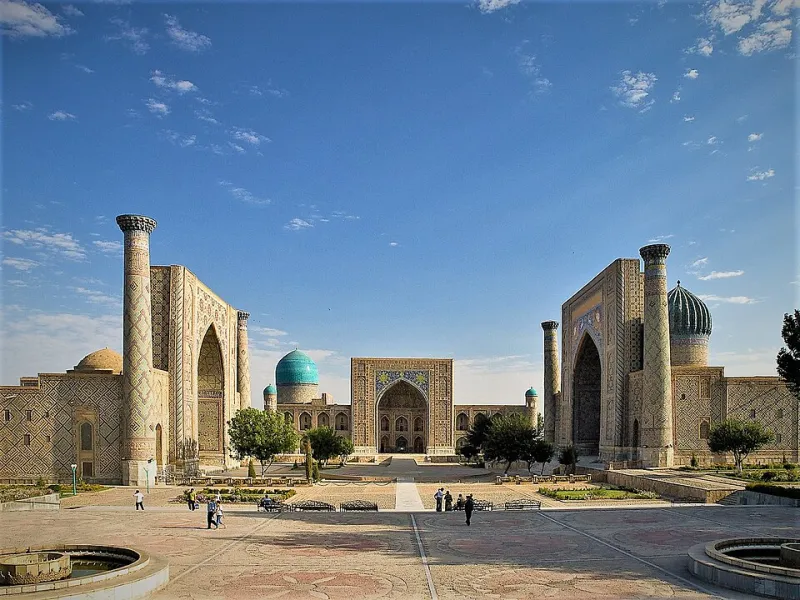
Photo: Registan_-_Gusjer.jpg: Gustavo Jeronimo from Aranjuez, Spain derivative work: MrPanyGoff, CC BY 2.0, via Wikimedia Commons
Marco Polo didn't travel a road. He traveled an idea.
The Silk Road — that vast, shifting network of overland and maritime routes connecting China to the Mediterranean — was never a single, paved path. It was a conversation. Caravans moved silk west and gold east, yes, but they also moved Buddhism, Islam, paper, gunpowder, the bubonic plague, musical instruments, architectural techniques, and recipes. Everything humanity has ever made has, in some form, traveled a version of this route.
Seven centuries after Polo made his journey, the corridor he followed is still open. And for travelers willing to venture into Central Asia's underexplored interior, it offers something rare: a place where history isn't behind glass.
Why This Route, Why Now
Most American travelers have never seriously considered Uzbekistan, Kyrgyzstan, or the Xinjiang region of western China as destinations. The region sits in a blind spot — too far east to feel European, too far west to fit neatly into most people's idea of Asia, and with a geopolitical complexity that can make it feel complicated before you've even looked at flights.
But the practical picture has shifted considerably in the past decade. Uzbekistan in particular has undergone a quiet tourism transformation since 2016, when the country's new government began issuing e-visas and loosening restrictions that had made independent travel difficult. The results are visible on the ground: improved infrastructure, more guesthouses, better transport connections — and still, mercifully, nowhere near the crowds that have overwhelmed more famous destinations.
This is a corridor that rewards the curious. But it helps to understand what you're walking into.
Samarkand: Where the World's Ambitions Came to Rest
If the Silk Road has a capital city, it's Samarkand.
Timur — known in the West as Tamerlane — made it so in the 14th century, dragging the world's finest architects, craftsmen, and scholars to his capital and building what was, for a moment, the most dazzling city on earth. The Registan — three towering madrasahs arranged around a central plaza, their facades covered in geometric tilework in shades of cobalt, turquoise, and gold — is the physical result of that ambition.
Photographs don't prepare you for the scale of it. Standing in the Registan at early morning, before the tour groups arrive, is one of those rare travel moments when the gap between expectation and reality closes in the right direction.
But Samarkand's deeper lesson isn't aesthetic. It's genealogical. The tilework patterns are Persian. The architectural forms are influenced by Mongol, Turkic, and Chinese traditions. The calligraphy is Arabic. The city itself is a physical record of cultural exchange — every surface a palimpsest of borrowed ideas, refined and transformed by the people who made them their own.
This is what the Silk Road actually did. Not blend cultures into sameness, but create the conditions for something new.
Bukhara and the Texture of Lived History
Two hours west of Samarkand by fast train, Bukhara operates on a different frequency.
Where Samarkand is monumental, Bukhara is intimate. Its old city — a UNESCO World Heritage Site — is also a functioning neighborhood. People live in the houses that surround the Kalon Minaret. Families run tea houses in rooms that have been tea houses for five hundred years. The covered bazaars, though now aimed partly at tourists, still feel like the markets they've always been.
For travelers, Bukhara offers something Samarkand doesn't quite: the sense of a city that has absorbed its history rather than being curated by it. Walk far enough from the main monuments and you'll find streets where nothing has been renovated, where an old man sits outside a door that might be a home or might be a workshop and probably both.
This is the texture that Silk Road travel offers consistently — the feeling that you've arrived somewhere that has been continuously inhabited, continuously traded through, continuously transformed, for longer than your country has existed.
Crossing into Kyrgyzstan: The Road Gets Wilder
Eastern Uzbekistan gives way to Kyrgyzstan through mountain passes that make the journey itself part of the point. The Fergana Valley — historically one of the Silk Road's most fertile and contested corridors — is lush and complicated, a region where Uzbek, Kyrgyz, and Tajik communities live in close proximity, the borders between their countries drawn by Soviet administrators who didn't particularly care about ethnic geography.
Kyrgyzstan is a different kind of Silk Road experience. The nomadic heritage here means that culture isn't stored in buildings — it's stored in practices. Yurt camps in the Tian Shan mountains offer travelers the chance to spend nights the way caravanners once did: under felt walls, eating lamb cooked over fire, listening to the wind work itself across open steppe.
The country's community-based tourism infrastructure, much of it developed through CBT (Community Based Tourism) Kyrgyzstan, is genuinely good and specifically designed to route tourism income to local families rather than international operators. For American travelers, this is one of the more accessible ways to experience nomadic culture without the performance layer that often comes with it.
The China Question
Any honest account of Silk Road travel has to address the elephant in the room: Xinjiang.
The westernmost region of China — home to Kashgar, the ancient oasis city that was once one of the Silk Road's great crossroads — is currently under a level of surveillance and political restriction that makes independent travel ethically and practically complicated. The Uyghur cultural crisis there is real and ongoing, and travelers should research it thoroughly before making decisions about visiting.
For those who do go, Kashgar's old city — partially demolished and partially reconstructed in recent years — still contains traces of what it once was: a place where caravans from a dozen directions converged, where you could hear six languages in a single market, where the Sunday livestock bazaar was one of the great spectacles of the trading world. Whether and how to engage with that history in the current political climate is a question each traveler has to answer for themselves.
What the Road Is Actually Teaching You
Traveling any portion of the Silk Road corridor does something specific to your understanding of the world. It makes cultural borrowing visible.
The minaret in Uzbekistan that echoes a Persian form. The Chinese architectural influence in Mongolian temple design. The grape varieties in Uzbek markets that traveled east from the Mediterranean two thousand years ago. The polo matches played in Kyrgyzstan that gave the sport its name before it ever reached the British Empire.
Every culture on this route built itself partly from what passed through. None of them are diminished by that. All of them are richer for it.
That's the argument the Silk Road makes, and it's one the modern world desperately needs to hear: that exchange isn't dilution. That contact between cultures produces something that neither culture could have made alone.
Marco Polo understood this. He spent 24 years moving through a world that was more interconnected than most of his contemporaries could imagine, and he came home changed by what he'd seen — not just in terms of what he'd witnessed, but in terms of how he understood the nature of civilization itself.
The road is still there. It still has things to say.
Planning Your Silk Road Journey: Practical Notes for US Travelers
- Visas: Uzbekistan now offers an e-visa for US citizens, valid for 30 days, available at e-visa.uzbekistan.gov.uz. Kyrgyzstan is visa-free for US passport holders for up to 60 days.
- Best time to travel: April–June and September–October. Summers in the lowlands are brutally hot; winters can close mountain passes.
- Getting there: Turkish Airlines and Air Arabia offer the most competitive routings from major US cities, typically connecting through Istanbul or Dubai.
- Internal transport: The Afrosiyob high-speed train connects Tashkent, Samarkand, and Bukhara efficiently. Shared taxis and marshrutkas handle shorter regional routes. For Kyrgyzstan's mountain areas, arrange transport through guesthouses or CBT Kyrgyzstan.
- Language: Russian is widely understood across the region and more useful than English in most contexts. Learning twenty words of Uzbek or Kyrgyz will open more doors than you'd expect.
- Guided vs. independent: First-time visitors to Uzbekistan can travel independently with reasonable ease. For deeper Kyrgyzstan, a local guide — especially for trekking routes — is worth the investment.