Broken Words, Real Connections: What Happens When You Can't Speak the Language
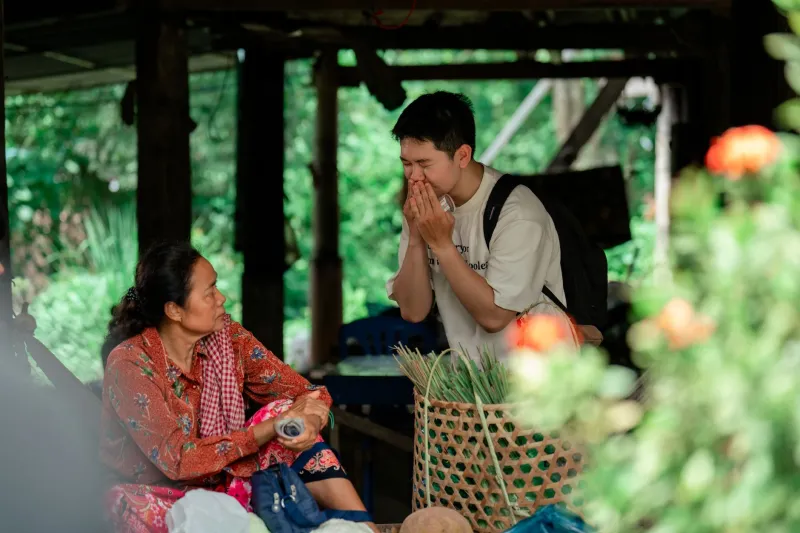
There's a specific kind of humiliation that only travelers know. You've rehearsed the phrase six times in your hotel room. You've listened to the audio guide. You've practiced the accent, or at least attempted something in the neighborhood of it. And then you open your mouth at the market stall or the train counter or the tiny family-run trattoria, and the person across from you stares at you with an expression somewhere between confusion and polite pity.
I know that feeling intimately. And I've come to love it.
Not in a masochistic way — but in the way you come to appreciate anything that strips you down to something honest. Because when you can't speak the language, you can't perform. You can't be charming or clever or confidently in control. You're just a person, standing in front of another person, trying to figure out how to exist together in the same moment. And that, it turns out, is exactly where real travel begins.
The Illusion of the Translated World
We live in an era of frictionless communication. Google Translate fits in your pocket. Duolingo promises conversational fluency in a few weeks of streaks. Most major tourist corridors have English menus, English signage, English-speaking staff who've long since adapted to the American traveler's preference for things to just work.
And there's nothing wrong with that, exactly. Accessibility matters. Not every traveler has months to prep a language before a trip.
But here's the quiet cost of seamless translation: it keeps you at arm's length from the place you came to experience. When every interaction is mediated by an app or a tour guide or a conveniently bilingual shopkeeper, you're not really navigating a foreign culture — you're navigating a version of it that's been smoothed down for your comfort. It's travel with the edges filed off.
The edges are where the good stuff lives.
What My Terrible Japanese Taught Me
A few years back, I spent three weeks in Japan — Tokyo, Kyoto, and a stretch of rural Tohoku that doesn't make it into many guidebooks. My Japanese was, to put it generously, decorative. I had arigatou gozaimasu down cold. Beyond that, I was largely operating on hope and hand gestures.
In Tokyo, this was mostly fine. The city is extraordinarily navigable even without the language. But in Tohoku — in the small towns where the restaurant menus were handwritten and nobody was particularly expecting an American to wander in — things got interesting.
At one point, I walked into what I thought was a noodle shop and ended up in what was clearly someone's home, or at least a home that had a few tables in it. An older woman came out, looked at me, looked at the door I'd just walked through, and then — rather than shooing me out — gestured for me to sit down.
What followed was one of the most memorable meals of my life. I have no idea what I ate. I pointed at things, she nodded or shook her head, and we built a meal together out of nothing but mutual goodwill and a shared willingness to figure it out. She laughed at my attempts to compliment the food. I laughed at myself. By the end, she'd brought out a small photo album — her grandchildren, I think — and was showing me pictures with the universal pride of a grandmother who wants you to understand that these kids are exceptional.
We didn't share a single coherent sentence. We shared something better.
The Body Remembers What Words Forget
There's real science behind what happens when verbal language fails us. We revert to a richer, older toolkit — facial expression, tone, gesture, proximity, eye contact. Researchers who study nonverbal communication estimate that somewhere between 70 and 93 percent of what we convey to each other happens outside of words entirely. Language, for all its sophistication, is almost an overlay on top of something more primal and more universal.
When you travel without linguistic fluency, you access that layer directly. You become more attentive. You watch faces more carefully. You notice when a shopkeeper's posture softens, when a stranger's eyes crinkle with genuine warmth versus polite tolerance. You stop waiting for words to tell you how an interaction is going and start reading the room the way humans have always known how to read a room.
This isn't romanticizing difficulty. It's recognizing that constraints can sharpen perception in ways that comfort never does.
On the Courage of the Imperfect Attempt
Here's something I've noticed across years of travel: locals almost universally respond better to a bad-faith attempt at their language than to a confident pivot to English. Not because they need you to speak their language — they don't — but because the attempt itself signals something. It says I see that this place belongs to you, not me. I'm a guest here, and I'm trying.
That's a fundamentally different posture than the one that says I'm an American, do you speak English? — a question that, however innocently intended, carries a faint but real implication that the burden of communication should fall on them.
Botch a greeting in Portuguese and a Lisbon local will almost always smile and meet you halfway. Do the same in rural Mexico, in a Moroccan souk, in a Greek fishing village, and you'll find that people are remarkably generous with travelers who are visibly, earnestly trying. The imperfect attempt is a form of respect. And respect, in any language, translates.
What to Do When the Words Run Out
If you're heading somewhere without much linguistic preparation — and most of us are, most of the time — a few things genuinely help.
Learn the basics, but don't stop at the tourist phrases. Yes, know how to say hello and thank you. But also learn I don't understand, please speak slowly, and I'm sorry, my [language] is very bad. That last one, delivered with a self-deprecating smile, is practically a universal icebreaker.
Carry a small notebook. Writing a number down or sketching a rough map bypasses a lot of spoken confusion. It also gives the other person something to respond to in kind, and suddenly you're collaborating instead of failing.
Let silences be okay. Americans, culturally, tend to be uncomfortable with conversational silence and rush to fill it. In many parts of the world, a quiet moment between strangers isn't awkward — it's just two people being present together. Resist the urge to fill every gap with noise.
And most importantly: stay in the discomfort long enough to see what's on the other side of it. The instinct when communication breaks down is to retreat — to the phone, to the translation app, to the English-speaking hotel concierge. Sometimes that's necessary. But sometimes, if you just hold the moment a little longer, something unexpected happens. A connection forms in the space where language ran out.
The Real Fluency
Marco Polo — the original one, the Venetian merchant who spent 24 years traveling through Asia in the 13th century — navigated dozens of languages, cultures, and courts across a world that had no translation apps, no phrasebooks, and no English menus. He learned by doing. By failing. By being, perpetually, the person in the room who didn't quite know the rules.
And somehow, through that persistent not-knowing, he managed to connect with people across an almost incomprehensible cultural distance.
That's the fluency worth chasing — not the ability to conjugate verbs correctly, but the willingness to show up imperfect and stay curious. To let the language barrier become a doorway instead of a wall.
The best conversations I've had abroad weren't in any language I speak well. They were in the language of showing up, stumbling forward, and trusting that another human being would meet me there.
They almost always do.